
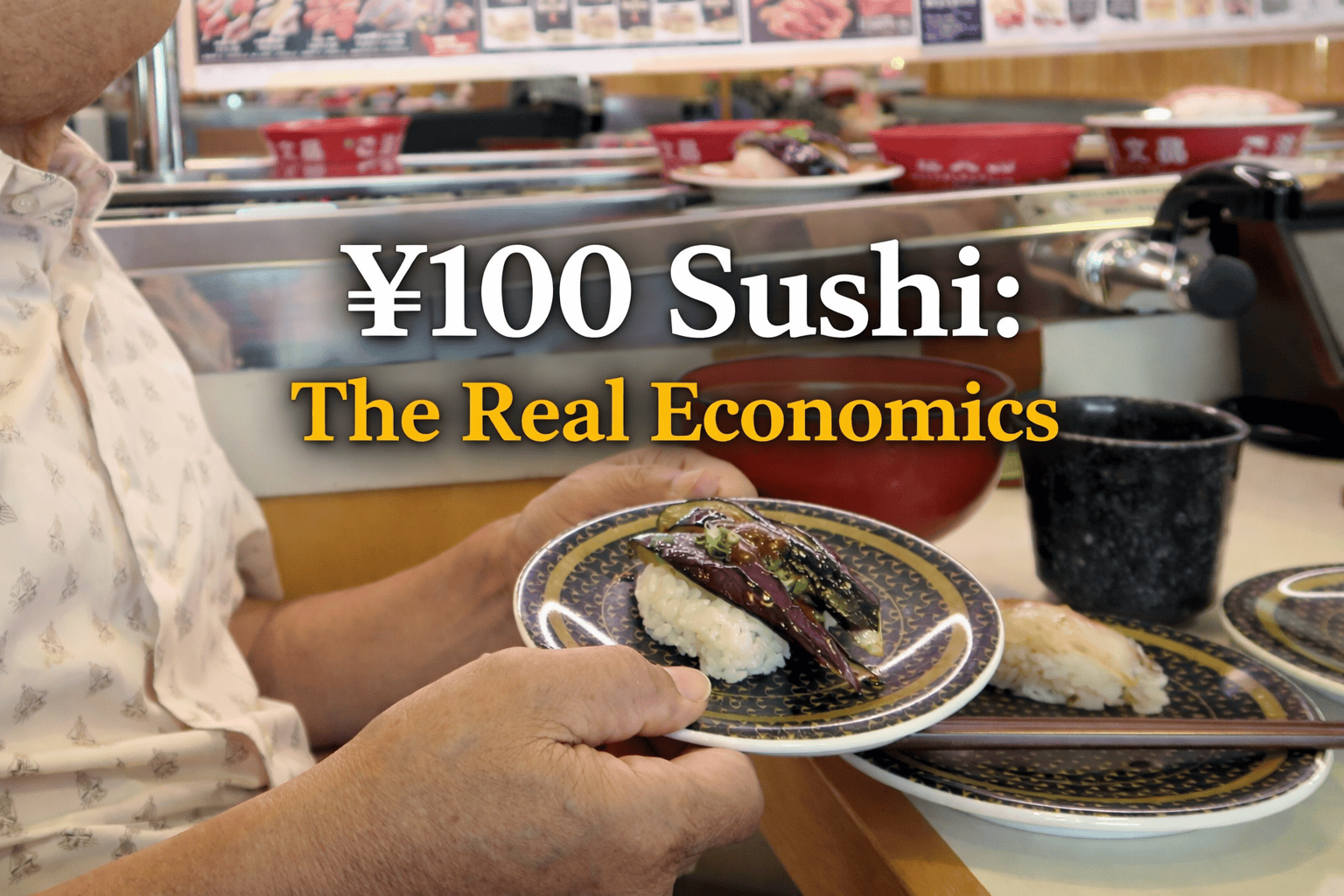
Cheap Is the Bait. The System Is the Profit.
Conveyor belt sushi didn’t win because fish is cheap.
It won because the system is precise.
After the 1990s recession, Japan wanted affordability.
Chains like Sushiro and Hama Sushi scaled hard.
Today the market is worth roughly ¥400 billion.
But the real question remains:
How does a ¥100 plate survive?
Not alone.
Not Every Plate Makes Money
Some plates barely break even.
Lean tuna might cost around ¥70–80 all-in after rice, labor, rent, logistics.
At ¥100 retail, that margin is thin.
But cucumber rolls?
Natto rolls?
Closer to ¥20 in raw cost.
High margin.
Meanwhile, fatty tuna can cost more than it sells for.
That’s intentional.
Profit doesn’t sit on a plate.
It sits in the mix.
Sushi Is the Hook. Sides Pay the Bills.
Average spend per customer: about ¥1,200.
Not all of that is sushi.
Ramen.
Udon.
Dessert.
Higher margins.
Drinks? Even better.
Powdered tea costs almost nothing.
Soft drinks and alcohol carry comfortable margins.
Sushi fills the seats.
Sides stabilize the math.
Speed Is Everything
Traditional sushi: 2–3 table turns per day.
Conveyor chains: 5–6.
Same chair.
Twice the revenue.
This is not a restaurant trick.
It’s volume engineering.
Automation Replaces Romance
No master chef shaping each piece.
Machines form rice.
Central kitchens process fish.
Touch panels collect demand data in real time.
Less waste.
Lower labor cost.
Predictable quality.
This is logistics wearing a sushi uniform.
Kajino’s Eye: Follow the Children
Chains love families.
Why?
Because children don’t order uni.
They order shrimp.
Tuna salad.
Cucumber rolls.
Low cost items.
When families dominate the dining room,
average spending stays high
while cost ratios stay controlled.
Customer mix is margin control.
The 100-Yen Illusion
The brand says “cheap.”
The bill often says ¥2,000.
For that price, you could eat a sushi lunch in Ginza.
Yet turnover here is three to four times faster.
How?
Keep the ¥100 plates visible.
Promote ¥400 plates as “Today’s Special.”
The logic becomes:
“It’s cheap here. I can splurge a little.”
Anchoring works.
Kajino’s Eye: The Five-Plate Nudge
At Kura Sushi, every five returned plates trigger a digital lottery.
It looks like a toy.
It’s not.
Eat 14 plates?
One more gives you a game.
That last plate happens more often than you think.
Gamification increases consumption.
Plate-return slots reduce labor.
No stacked plates means no visible evidence of how much you ate.
Behavioral economics, hygiene engineering, and social psychology —
wrapped in a children’s game.
Conclusion
100-yen sushi is not cheap food.
It is:
- Menu engineering
- Margin layering
- High rotation
- Automation
- Behavioral design
The plate says ¥100.
The system says profit.