
Tokyo is one of the most walkable cities in the world—but it is also exhausting. After hours of exploring temples, shopping streets, and train stations, every traveler eventually asks the same question:
“Where can I sit down for a while?”
Japan has an incredible variety of coffee chains, and each one serves a different purpose. Some are fast and efficient. Some are quiet and spacious. Others feel like a living room where you can stay for hours.
This guide explains the seven major café chains in Tokyo and when to use each one during your trip.
Instead of recommending individual stores, this page helps you understand how Tokyo’s coffee culture works.
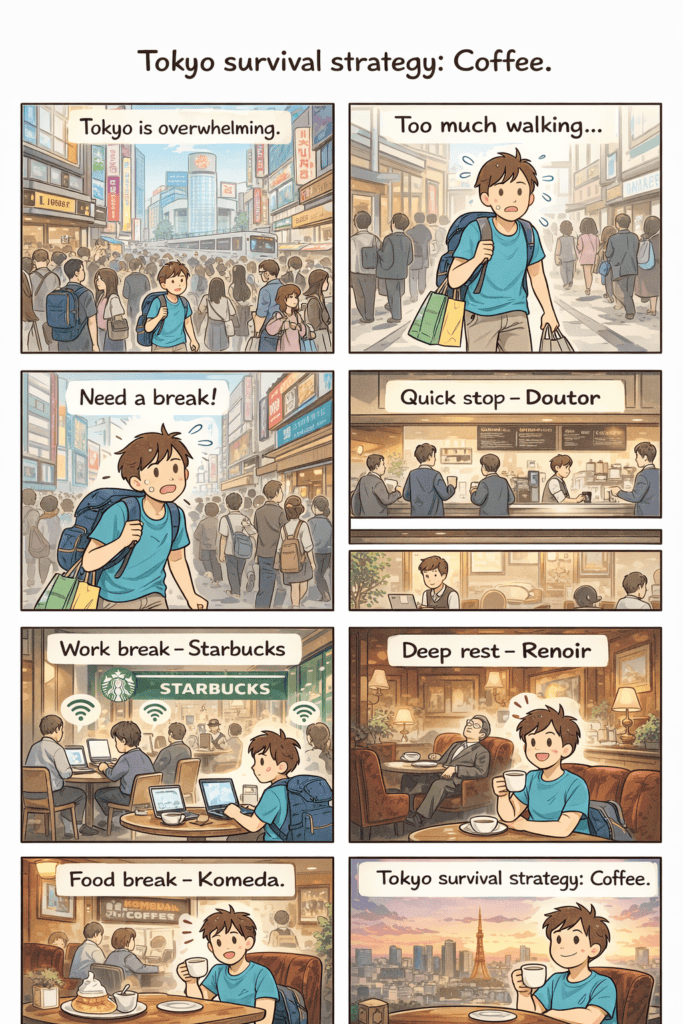
☕ The 7 Major Coffee Chains in Tokyo
Starbucks
Best for: Reliable breaks, Wi-Fi, and scenic locations
Starbucks in Japan is more than a familiar global brand. Many stores feature unique architecture or scenic locations, making them interesting stops during sightseeing.
One useful trick for travelers is the “One More Coffee” system, which allows you to buy a second drip coffee for a very low price on the same day. スタバ101
📍 Read the full guide
→ Starbucks 101
Doutor Coffee
Best for: Quick and cheap caffeine near stations
Doutor revolutionized the Japanese coffee industry by offering affordable coffee and fast service. It became the everyday café for workers, commuters, and retirees.
Today it remains one of the most practical places to stop for a quick rest near train stations. ドトールコーヒー101
📍 Read the full guide
→ Doutor Coffee 101
Tully’s Coffee
Best for: A quieter alternative to Starbucks
Tully’s positions itself as a more relaxed café experience. Many stores offer comfortable seating and a calmer atmosphere.
The chain is also known for high-quality beans and hand-drip coffee preparation, which appeals to travelers looking for a more refined coffee experience.
📍 Read the full guide
→ Tully’s Coffee 101
Komeda’s Coffee
Best for: Huge food portions and relaxed seating
Originally from Nagoya, Komeda’s Coffee is famous for generous food portions and extremely comfortable seating.
Japanese customers even joke about the chain’s “Reverse Fraud”—the food is much larger than the menu photos suggest. Komeda101
If you want a relaxed café that feels like a living room, Komeda is a great option.
📍 Read the full guide
→ Komeda Coffee 101
Cafe Renoir
Best for: Quiet work, meetings, and long stays
Renoir is one of Tokyo’s most unique café chains. Unlike fast coffee shops, Renoir focuses on providing space and time rather than just drinks.
Seats are intentionally spaced far apart, and customers are never rushed to leave. Cafe Renoir 101
This makes it a favorite for freelancers, business meetings, and travelers who need a peaceful place to sit.
📍 Read the full guide
→ Cafe Renoir 101
Hoshino Coffee
Best for: Retro atmosphere and desserts
Hoshino Coffee combines a retro Japanese café atmosphere with carefully prepared hand-drip coffee.
Its signature dish is the famous soufflé pancake, which is baked after ordering and takes about 20 minutes to prepare. Hoshino Coffee 101
This makes it a great place for a relaxed afternoon break.
📍 Read the full guide
→ Hoshino Coffee 101
Caffè Veloce
Best for: Cheap coffee and spacious seating
Veloce is one of the most underrated café chains in Tokyo. It offers extremely good value, large seating areas, and a calm atmosphere.
Many stores provide Wi-Fi and power outlets, making it a convenient place to rest or work during long sightseeing days. Caffe Veloce 101
📍 Read the full guide
→ Caffè Veloce 101
🧭 How Locals Actually Use These Cafés
Each chain fills a different role in daily life.
Quick stop
→ Doutor
Reliable break
→ Starbucks
Quiet working space
→ Renoir
Relaxed dessert café
→ Hoshino
Living-room comfort
→ Komeda
Budget rest stop
→ Veloce
Balanced café experience
→ Tully’s
Understanding these differences helps travelers choose the right place depending on the situation.
☕ Why Japan Has So Many Coffee Chains
Japan has an unusually large number of coffee chains compared with many other countries.
One reason is the structure of Japanese cities. Train stations act as major hubs where thousands of commuters pass every hour. Cafés naturally developed around these stations as places for quick breaks before or after commuting.
Another factor is Japan’s long kissaten culture—traditional coffee shops that existed long before modern chains arrived. Many of today’s coffee chains inherited this culture, focusing not only on coffee but also on providing a comfortable place to sit and relax.
As a result, Japanese coffee chains evolved into different “roles,” ranging from quick commuter cafés to spacious living-room-style lounges.
☕ Final Tip: Coffee Chains Are Tokyo’s “Urban Rest Stations”
Tokyo is dense, busy, and full of energy. Coffee chains act almost like public rest stations where people pause between activities.
Learning how to use them will make exploring the city far more comfortable.
And once you know the differences between the major chains, you can always find the right place to sit down, recharge, and watch Tokyo life unfold.