

This guide lists all Michelin-starred and Bib Gourmand restaurants in Tokyo for 2026, organized by genre and district.
It is designed to help travelers quickly find top restaurants near their destination.
Tokyo continues its unprecedented reign as the world’s Michelin star capital for the 19th consecutive year. Since the guide’s debut in Asia, Tokyo has remained undefeated. With 274 establishments featured in the 2026 edition, Tokyo surpasses every other global city—Paris and New York included—across all categories.
This article is the definitive roadmap to Tokyo’s Michelin universe. We analyze the 274 Michelin-listed establishments from unique perspectives: statistical breakdowns, the secrets behind Tokyo’s culinary dominance, and the “gap” between global ratings and local reality.
📊 2026 Michelin Guide Tokyo: By the Numbers
In 2026, a total of 526 establishments received distinctions. However, this guide focuses on the 274 restaurants that earned actual Star or Bib Gourmand titles (excluding Selected candidates).
Michelin Guide Classification System
🍀 Green Star: Excellence in sustainability (13 establishments).
⭐⭐⭐ Three Stars: Exceptional cuisine worth a special journey (12 restaurants).
⭐⭐ Two Stars: Excellent cooking worth a detour (26 restaurants).
⭐ One Star: High-quality cooking worth a stop (122 restaurants).
😋 Bib Gourmand: Outstanding value under ¥5,000 (114 restaurants).
Tokyo’s 274 Restaurants by Genre
2026 Michelin Guide Tokyo:
| Cuisine Type | ⭐⭐⭐ | ⭐⭐ | ⭐ | Bib Gourmand | Total |
|---|---|---|---|---|---|
| STARRED CUISINES | |||||
| French | 5 | 6 | 37 | 21 | 69 |
| Japanese Cuisine | 5 | 12 | 31 | 5 | 53 |
| Sushi | 1 | 3 | 19 | 6 | 29 |
| Chinese | 1 | 0 | 6 | 6 | 13 |
| Tempura | 0 | 2 | 9 | 2 | 13 |
| Italian | 0 | 1 | 5 | 11 | 17 |
| Innovative | 0 | 2 | 1 | 0 | 3 |
| Contemporary | 0 | 0 | 4 | 0 | 4 |
| Beef Cuisine | 0 | 0 | 2 | 0 | 2 |
| Unagi (Eel) | 0 | 0 | 1 | 5 | 6 |
| Spanish | 0 | 0 | 1 | 4 | 5 |
| Yakitori | 0 | 0 | 1 | 3 | 4 |
| Shojin Ryori (Buddhist Vegetarian) | 0 | 0 | 1 | 0 | 1 |
| Crab Cuisine | 0 | 0 | 1 | 0 | 1 |
| Creative Cuisine | 0 | 0 | 1 | 0 | 1 |
| Thai | 0 | 0 | 1 | 0 | 1 |
| Austrian | 0 | 0 | 1 | 0 | 1 |
| BIB GOURMAND ONLY CUISINES | |||||
| Ramen | 0 | 0 | 0 | 16 | 16 |
| Soba | 0 | 0 | 0 | 12 | 12 |
| Tonkatsu | 0 | 0 | 0 | 8 | 8 |
| Yoshoku (Western-Japanese) | 0 | 0 | 0 | 4 | 4 |
| Izakaya | 0 | 0 | 0 | 3 | 3 |
| Indian | 0 | 0 | 0 | 3 | 3 |
| Sri Lankan | 0 | 0 | 0 | 1 | 1 |
| Onigiri (Rice Balls) | 0 | 0 | 0 | 1 | 1 |
| Pork Cuisine | 0 | 0 | 0 | 1 | 1 |
| Southeast Asian | 0 | 0 | 0 | 1 | 1 |
| Portuguese | 0 | 0 | 0 | 1 | 1 |
| TOTAL | 12 | 26 | 122 | 114 | 274 |
Michelin Guide Tokyo by Percentage
French, Japanese cuisine, and sushi establishments represent 54% of all Michelin-recognized restaurants in Tokyo.
- French: 24%
- Japanese Cuisine: 20%
- Sushi: 10%
- Other 24 genres: 46%
18 Establishments Newly Awarded Stars in 2026
Newly Awarded Stars
Three Stars:
- Myojaku (明寂) – Japanese Cuisine – Promoted
Two Stars:
- Nishiazabu Sushi Shin (西麻布 鮨 真) – Sushi – Promoted
- Hakuun (伯雲) – Japanese Cuisine – Promoted
- Ensui (炎水) – Japanese Cuisine – Promoted
One Star:
- Sushi Yuki (鮨 ゆうき) – Sushi – Promoted
- KIBUN (氣分) – Contemporary – Promoted
- Sushi Miura (鮨 みうら) – Sushi – Promoted
- Sassa (佐々) – Japanese Cuisine – New
- MANOIR (マノワ) – French – New
- Sushi Oya (鮨 大矢) – Sushi – New
- Takumi Tatsuhiro (匠 達広) – Sushi – New
- Hyakuyaku by Tokuyamazushi (百薬 by 徳山鮓) – Japanese Cuisine – New
- KHAO (カオ) – Thai – New
- Akasaka Shimabukuro (赤坂 島袋) – Japanese Cuisine – New
- EWIG (エーヴィック) – Austrian – New
- Sushi Tanaka (鮨 田中) – Sushi – New
- La Gloire (ラ グロワ) – French – New
- TROIS VISAGES (トワヴィサージュ) – French – New
Genre-Based Restaurant Navigation
(Make sure to check the scrollable list below!)
We have compiled a complete list of all 274 restaurants, organized by genre and district. This is a unique feature of “Tokyo Smart,” designed to help you find the perfect starred restaurant near your hotel or destination—something no other guide offers in this detail.







🌏 Tokyo: The World’s Premier Culinary Capital
Tokyo vs. Other Global Cities
Why is Tokyo number one? The numbers speak for themselves.
- Tokyo: 160 Starred Restaurants (Total listed: 526 including Bib/Selected)
- Paris: Approx. 133 Starred Restaurants
- New York: Approx. 71 Starred Restaurants
Although cities like London, Kyoto, and Osaka are world-class destinations, Tokyo’s volume and quality are in a league of their own.
Why Does Tokyo Concentrate Michelin Recognition?
According to data from Hitosara and Kanko Keizai Shimbun, two main factors contribute to this dominance:
The “UMAMI” Literacy: Japanese chefs and diners have a highly developed sensitivity to “Umami” (the fifth taste). Since Washoku (Japanese cuisine) was recognized as a UNESCO Intangible Cultural Heritage in 2013, the world has finally caught up to what Tokyo has known for centuries.
Geography & Climate: Japan is 75% mountainous and surrounded by the ocean. The distinct four seasons and diverse terrain provide an explosion of high-quality ingredients—seafood, mountain vegetables, and fruits—that are unmatched globally.
⚡ Michelin’s Challenge: The Gap Between Global Ratings and Local Reality
Michelin’s Challenge: The Cultural Paradox
While Michelin has successfully highlighted Tokyo’s brilliance, a quiet friction remains between the guide’s Western philosophy and Japan’s traditional values. Several top-tier Japanese restaurants have reportedly declined the three-star honor. Why would a chef refuse the world’s most prestigious award? This resistance hints at the guide’s next evolutionary challenge.
Reason 1: Protecting the “Regulars” (Ichigen-san Okotowari) Michelin’s influence is too powerful. Even a Bib Gourmand mention can generate queues that last for hours. For strictly reservation-only establishments, a star often means seats are booked out by international tourists six months in advance. Chefs worry: “If my restaurant is filled with one-time visitors from abroad, where will my loyal regulars—who have supported me for decades—sit?” In Japan, the relationship between a chef and a regular customer is built on years of trust, not just a single transaction. Michelin’s global wave threatens to break this delicate ecosystem.
Reason 2: Can a “Western Palate” Truly Judge the “Japanese Soul”? This is the core of the debate. Michelin evaluates what is on the plate. However, Japanese cuisine is built on invisible layers: fermentation techniques passed down for 600 years, the intricate handling of dashi (broth) that changes with the humidity, and the philosophy of “subtraction”—removing the unnecessary to highlight the essence. A profound question exists among Japanese culinary masters: “Can an evaluation system born in France truly measure the depth of a cuisine developed in isolation over centuries?”
It is not just about flavor pairing (though the clash between delicate Japanese broth and heavy French wine standards is one example). It is about whether a visiting inspector can perceive the decades of discipline behind a single bowl of soup. The “Narikura” Case: In 2026, Tonkatsu Narikura—widely considered by locals to be the pinnacle of pork cuisine—lost its Michelin recognition. Yet, on Tabelog (Japan’s user-driven restaurant ranking), it holds a staggering score of 4.26, a rating usually reserved for legendary three-star establishments. This discrepancy illustrates the gap: Japanese food enthusiasts see a master at work, while international criteria may miss the nuance entirely.
👨🍳 A Chef’s Lifetime Journey: The Path to “Takumi”
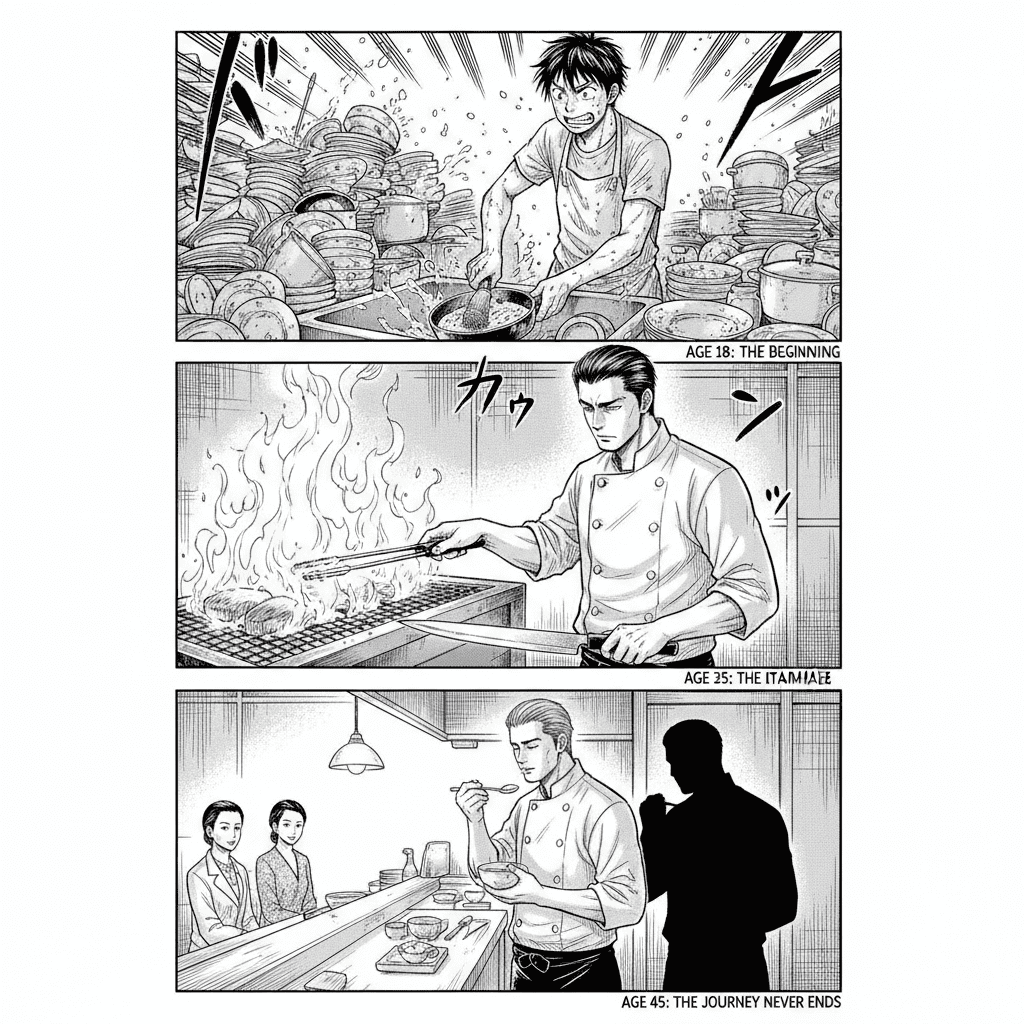
To understand the quality of Tokyo’s food, one must understand the life of its chefs. According to the Japan Finance Corporation, the average age for a chef to open their own restaurant is 43.6 years old.
- Age 18-20: Basic training (cleaning, prep).
- Age 20-25: Plating and aesthetic sensibility.
- Age 25-30: Grilling and frying (mastering fire).
- Age 30-35: Steaming and Dashi (mastering flavor).
- Age 35-40: Head Chef (Itamae) training—management and customer service.
At age 43, when many athletes retire, a Japanese chef is just beginning their independent career. They work 12-14 hours a day, focusing their entire life on perfecting a single craft. This level of dedication creates the “Takumi” (Master) culture that supports Tokyo’s stars.
👁️ Kajino’s Eye: The Secret World of Fermentation
Japanese cuisine’s “secret sauce” isn’t a sauce at all—it’s history. Fermentation culture (Miso, Soy Sauce, Sake) originated over 600 years ago. Koji (malt) makers protect their “ancestor fungi” with their lives. These microscopic organisms have survived wars and disasters, passed down only to a single successor. When you eat a Michelin-starred Japanese meal, you aren’t just tasting ingredients; you are tasting 600 years of preserved living history.
This guide is updated based on the Michelin Guide Tokyo 2026. For the specific list of restaurants, please refer to the scrollable section above.






コメント